
Mediation & Active Listening
Opportunities to Pause & Reflect
At each time stamp listed below, answer the provided questions. You can download or print a discussion guide for these prompts here, or by visiting the lesson materials tab.
Pause at 8:15
Question Group 1
- Which conflict handling style (Avoider; Accommodator; Competitor; Dealer; Mediator) do you feel you settle into most often?
- Would you consider changing your style; and if so, what specific steps would you take?
Question Group 2
- Is it possible to change styles? What do you think?
- Behavioral style – who you are — probably not
- Conflict handling – what you do – probably yes
Question Group 3
- How can you develop greater awareness of your conflict handling style?
- Awareness of how your actions affect interpersonal relationships and teamwork
- Changing habits – try something new
Suggestions for Mediators
- How well mediation goes depends on the people involved; you’re a facilitator
- Rely on your listening skills
- Focus as narrowly as you can on one dispute
Resources
Ted Talk _ Dorothy Walker _ Three Ways to Resolve a Conflict
YouTube Video _ Mediating Employee Conflict
Pause at 14:05
- Think about a time when you could have used the quick mediation skill
- How might quick mediation have changed the outcome?
Suggestions for Active Listening
- Practice listening for the “feeling” words (practice while watching a drama where actors convey feeling and emotion)
- Practice at home!
- Anger is often a mask for another feeling – what feelings or emotions are sometimes covered up?
- Value of silence
- Minimal responses – mmm hmm, ok
- Questions are ok, but…
- More than words – you have visuals
- Culture matters
Resources
Active Listening Skills
Five Easy Ways to Practice Active Listening
Understanding Styles—Animated Video
Brief Overview of Conflict
Short Scenario Discussions
- Review and discuss of short scenario #1 (download handout)
- Review and discuss of short scenario #2 (download handout)
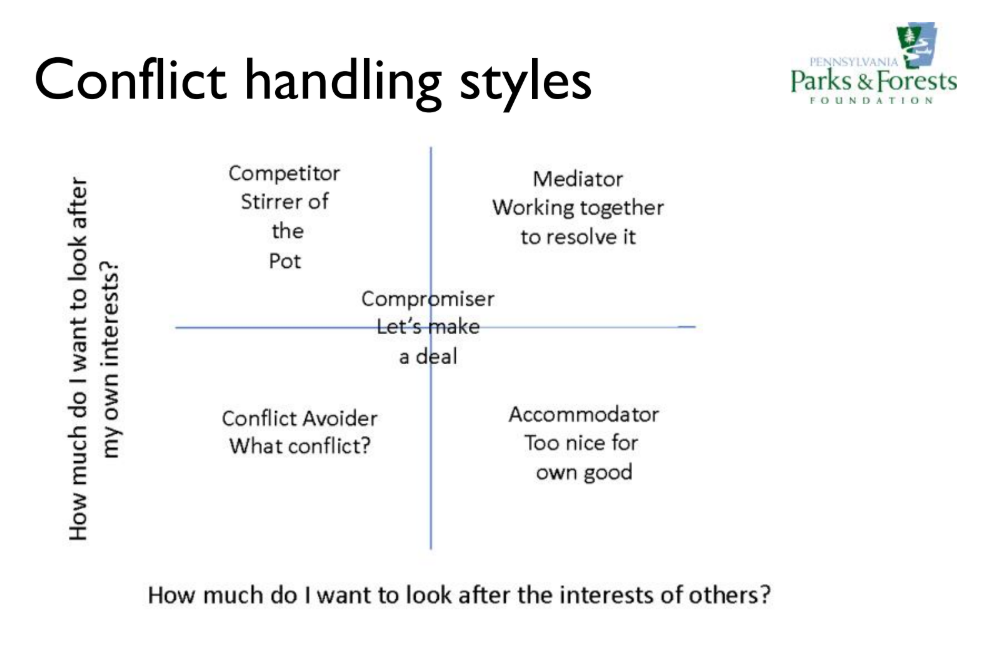
Conflict Handling Styles chart.