Brushing & Trees on The Trail
Brushing Assessments
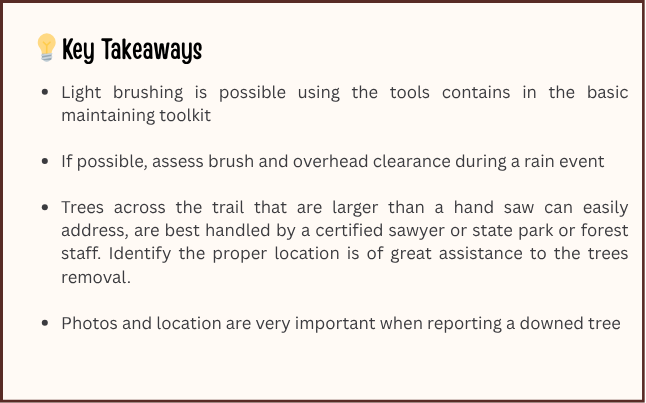
Assessing for brushing is generally much easier than assessing for water, since, in most cases, encroachment by vegetation is readily apparent. You should keep in mind what the trail usages are, and what the standards are for trail width and overhead clearance. A multi-use trail also has a need for line-of-sight clearance when bicycle and horse use is permitted. Once you know what these standards are, make note of problem areas and what tools might be needed to fix the problem. Vegetation can force trail users to one side or the other, resulting in trail-creep over time. Overhead clearance is best checked during, or after a rain event, as vegetation will droop down more when wet. Are there saplings growing on or near the treadway that may become a future problem? Are there aggressive nonnative species that should be removed? Any issue that you see, you should use waypoints, maps, etc., to pinpoint these areas.
Downed Trees & Chainsaw Usage
I will not be going over chainsaw safety, except to say that permission to use a chainsaw must always be obtained from not only from the Pennsylvania Parks and Forests Foundation if you are a PPFF volunteer, but you must be sure to show that you are properly trained to the park or forest manager where you are volunteering. Agencies that oversee trail systems will often require volunteers to show proficiency and safety skills by taking a certification class. PPFF has a comprehensive chainsaw policy that includes a training course that the volunteer must pass and be regularly updated on. I will share a link to PPFF chainsaw policy in the resources.