
Native Plants Through the Seasons
Written By: Jaci Braund
Pennsylvania is home to about 2,000 native plant species, and while I can’t highlight them all in this brief blog, I am excited to showcase some native plants through each of the seasons, as featured in our Pennsylvania state parks and forests.
Spring
At the time of this writing, it is a beautiful spring day in Pennsylvania and this entire season inspired the writing of this piece. Spring is a time of renewal, new energy, and most exciting to me – a huge flush of flowers at every turn. Looking past the tulips and cherry trees in your neighborhood, you’ll find what is referred to as spring ephemerals in nearby forests. There are dozens of native herbaceous wildflowers that put on a dazzling show in the spring time, all before their overarching canopy trees leaf out. Trillium, dutchman’s breeches, spring beauty, bloodroot, violets, bluebells, cut-leaf toothwort, just to name a few! The show starts to fade around mid-May as our forests catch up and their leaves grow larger; emphasizing their ephemeral, or short-lived nature. Find lush landscapes of a variety of spring ephemerals in mesic forests with rich soils like Raccoon Creek State Park or Gifford Pinchot State Park.
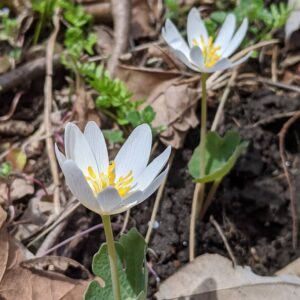
Bloodroot. Photo credit: Jaci Braund
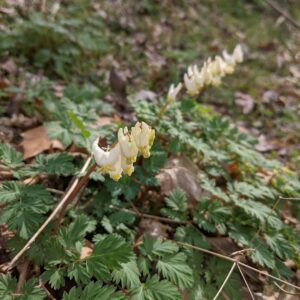
Dutchman’s Breeches. Photo credit: Jaci Braund
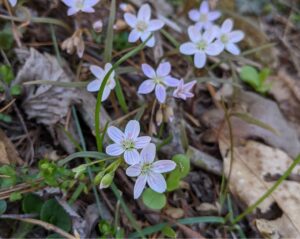
Spring Beauty at Raccoon Creek State Park. Photo credit: Jaci Braund
Summer
As the summer heats up we are blessed with the mountain laurel show. Mountain laurel is our state flower and I take great pride in that fact. It’s an annual pilgrimage of mine to find a dense thicket of mountain laurel, take about 100 new pictures, and watch (and listen!) native bees do their buzz pollination. The buzz is actually quite loud when you are nearby, and it helps to release the pollen from the flower. The flowers of mountain laurel vary in shades of light pink to white, and are closely related to rhododendrons and azaleas. They are primarily found on acidic ridgelines such as the Michaux State Forest.
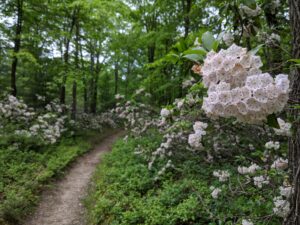
Mountain Laurel in the Michaux State Forest. Photo credit: Jaci Braund
Fall
While the sun and warmth begin to wane in the fall, the blooms do not. Goldenrod and many species of aster continue to brighten the days alongside the colorful trees. Several species all within the Aster family thrive through October: white snakeroot, ironweed, and a few species with common names of aster (Symphyotrichum sp.). Look for these in forests, along roadsides and in fallow fields in Pine Grove State Park and Kinzua Bridge State Park.
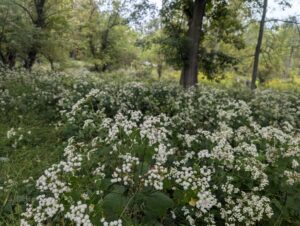
White Snakeroot at Pine Grove State Park. Photo credit: Jaci Braund
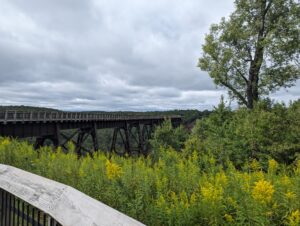
Goldenrod at Kinzua Bridge. Photo credit: Jaci Braund
Winter
What’s left in the winter while the bees, bears, and people are hibernating? Plenty. Many native plants are just now releasing their seeds onto the cold ground, just in time to be encased in snow for a few weeks for their necessary cold stratification. Because native plants have adapted to this climate, their seeds require a period of cold in order for their seeds to properly germinate. Some species will remain visible throughout the winter, such as American holly, which will continue to feed non-migratory birds with its red berries. Christmas fern is a native fern, with its pinnae shaped like little mittens, will also be visible throughout the winter, as long as it’s not covered in snow! Find these both in the Weiser State Forest.
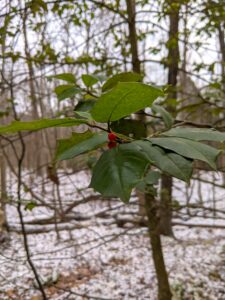
American Holly in Weiser SF. Photo credit: Jaci Braund
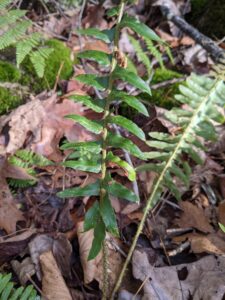
Christmas Fern in Weiser SF. Photo credit: Jaci Braund
About the Author:

Jaci Braund is an enthusiastic advocate for Pennsylvania’s native species and biodiversity at large. She is an Ecological Consultant, Conservation Director at the Fungal Diversity Survey, and also Vice President of the Pennsylvania Native Plant Society. Jaci has spent about 15 years getting to know plants, wildlife, and plant communities in the Mid-Atlantic region, and is eager to continue to speak for the trees.