


The world of fishing has its own language, and if you aren’t already familiar with the vocabulary, it can be overwhelming to figure out what you’re supposed to be doing. For example, the Fish and Boat commission defines fishing, “as the act of angling, or to catch, take, kill or remove, or the attempt to catch, take, kill or remove, from any waters or other areas within or bordering this Commonwealth any fish by any means or method for any purpose whatsoever.” What do words like “take” and “remove” mean in this context? If those are different from “catch,” then what, even, does “catch” mean? Here are a list of some of the common words associated with fishing and their definitions:
Catch– Hooking a fish and bringing it to shore.
Take– Keeping a caught fish for some purpose as opposed to releasing it.
Season– The period of time where it is legal to fish
Minimum Size– The minimum total length of the fish to be legally taken. Total length is the distance from the tip of the snout (mouth closed) to the furthest end of the tail (compressed).
Creel Limit– The maximum number of fish that can be caught within a specific timeframe. Daily creel limits are common.
Game Fish/Sport Fish– These are the large fish that are the targets of recreational fishing. Some common game fish include trout, pike, perch, and bass. If it isn’t a baitfish, it is a game fish.
Baitfish– Any fish used to bait a line for fishing. These are usually smaller fish like minnows, but any legally taken game fish can be used as baitfish as well. “It is unlawful to use or possess goldfish, comets, koi and Common Carp as baitfish while fishing.”
Fish Bait– Any non-fish animal used to bait a line for fishing. Common fish bait includes insects, crayfish, and crabs.
Trout Streams: Stocked– Stocking is when fish are raised in a fishery and then transferred to the wild once they are large enough, so a stocked trout stream is stocked with these fishery-raised trout.
Trout Streams: Keystone Select– Streams are stocked with larger trout.
Trout Streams: Special Regulation– Trout streams under a special set of regulations.
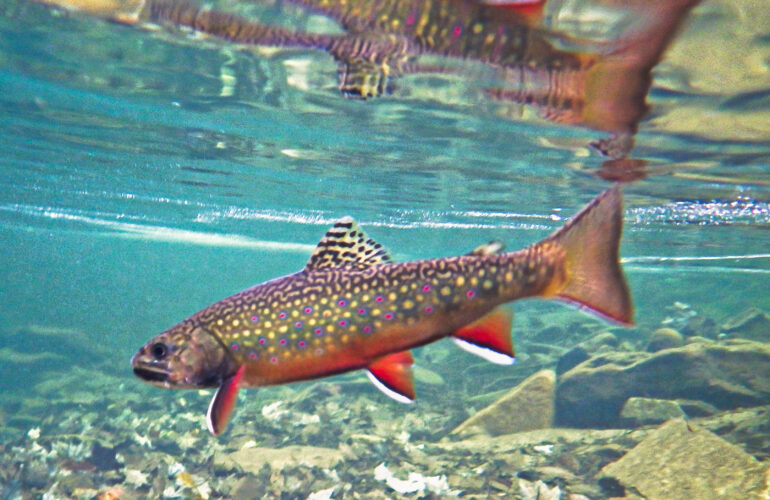
Trout Streams: Wilderness– Wilderness trout streams are defined based on their remoteness. They are typically a very natural environment.
Trout Streams: Natural Reproduction– Natural reproduction trout streams have a consistent population of wild trout, although they may also be stocked.
Trout Streams: Class A– Class A streams have a wild population of trout of great enough size and abundance to support a sport fishery. Class A streams are also natural reproduction streams, may be stocked streams, and may be wilderness streams.
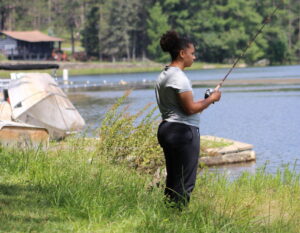
Photo by Beth Vanhorn at Parker Dam State Park
How to Fish
How can you attempt to catch, take, or kill a fish from PA waters? You just need four things. Firstly and most important, you need a fishing license, which can be purchased at https://huntfish.pa.gov/ . Then you just need a fishing rod, a reel, and tackle.
Fishing Rod- The fishing rod is the backbone of recreational fishing, both in a literal sense of pulling the fish up and a metaphorical sense as it is the most obvious part of the fishing gear. The reel is actually separate from the pole, but absolutely essential.
Reel- The reel is how you pull the fish up by winding up the line.
Tackle- Finally, tackle is how you actually grab the fish’s attention and body. Tackle (specifically terminal tackle) often includes the hooks, sinkers, and bait/lures.
Hook– The hook’s function is the most intuitive: this piece of tackle is what attaches the fish to the line so that it can be pulled up.
Sinker– The sinker is essential for causing the end of the line to sink into the water where the fish are. Without a sinker, the line would just float on top of the water, which eliminated the potential to catch certain fish.
Bait/Lures– Bait and lures are what entices the fish to bite the hook. Lures are typically manmade, whereas bait is usually alive/fresh (think worms).
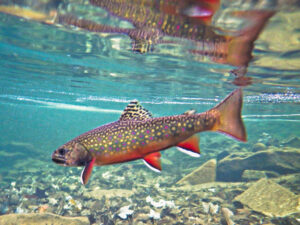
Photo by Terry Malloy in Moshannon State Forest
Types of Fishing
With these four items (permit, rod, reel, and tackle), you are equipped for the most basic kind of fishing, sometimes called angling. There are other ways to fish recreationally in Pennsylvania, though, like fly fishing, kayak fishing, and ice fishing.
Angling
Angling is what most people picture when imagining fishing. Angling involves standing still somewhere, casting your line, and slowly reeling it in to see what bites. All you need to begin angling is a fishing permit, rod, reel, and tackle.

Photo by Kevin Horn at Jacobsburg Environmental Center
Fly Fishing
Fly fishing is a technique where the angler flings the line about the water in a way that mimics the movements of the target fish’s prey. Because of the comparatively drastic movement required for fly fishing compared to angling, special equipment is needed, specifically a dedicated fly rod, fly reel, and fly line. Fly rods are typically much longer than your average fishing pole to generate more leverage for greater movements of the tackle, and the reel and line are much lighter to make it easier to swing the tackle upward like a flying insect. Many people find fly fishing to be more engaging than simple angling, so if you haven’t tried it before, it’s worth giving it a shot!
Kayak Fishing
Kayak fishing is basically just fishing from a kayak instead of from the shore. The benefit of kayak fishing is that you can go to hard-to-reach areas of a waterway to fish, and also you get to enjoy kayaking! The equipment and regulations for kayak fishing are the same as angling, plus a few additional pieces that have to do with the kayak. Obviously, you need a kayak to kayak fish, and that kayak has to either be registered with the fish and boat commission, or you need a launch permit to paddle on public waterways. You can register your kayak with the Fish and Boat commission at https://www.pa.gov/agencies/fishandboat/boating/register-title-a-boat/unpowered-boats.html or you can buy a launch permit at http://huntfish.pa.gov/. Also, you need to wear a personal floatation device, like a life jacket.
Ice Fishing
Ice fishing allows you to enjoy the sport of angling even during the winter. The equipment and regulations for ice fishing are basically the same as angling, you just need to bring a chisel to make a hole in the ice to fish in. The catch is that ice fishing can be dangerous. The ice could break, causing you to fall into freezing waters. For these reasons, additional safety equipment is necessary, like a personal floatation device, ice picks, and a rope. The PFD will help you to stay at the surface of the water should you fall in. The ice picks can help you to climb out of the water. Make sure you know how to use them properly before going out to ice fish. The rope is an additional safety measure to secure you to shore. Finally, the single greatest thing you can bring with you out on the ice to increase your safety is another person. Fishing with a friend improves the chance of a quick rescue if things go south, and also it’s more fun to fish with friends! Just make sure you aren’t both standing on the thin ice. The Fish and Boat Commission has good information on assessing the thickness of ice for fishing from: https://www.pa.gov/agencies/fishandboat/fishing/basics/ice-fishing.html
Rules and Regulations
Now you know how to fish, but what are the rules? Firstly and most importantly, everyone over the age of 16 needs a valid fishing license in order to legally fish in public waters of Pennsylvania. Additionally, there are some restrictions on when, where, what, and how you can fish, so becoming acquainted with the laws of your area is an important step. The basic rules and regulations will be reviewed here next, but for a more in depth explanation and region-specific laws, go to the Pennsylvania Fish and Boat Commission’s 2025 Fishing Summary booklet at https://www.pa.gov/content/dam/copapwp-pagov/en/fishandboat/documents/fishing/regulations/summarybook.pdf
Fishing License
When you go to purchase a fishing license, there are a few different options. The most basic fishing license allows you to fish for any non-trout fish on public waters that are not Lake Erie, Presque Isle Bay, and their tributaries. If you want to fish for trout, then you also need to purchase a trout permit. If you want to fish on Lake Erie, Presque Isle Bay, and their tributaries, then you need to buy a Lake Erie Permit. When you purchase a fishing license, you can pay for one, three, five, or ten years of permitted fishing. If you buy a basic fishing license and want to later add the trout and/or Lake Erie permit, you can do so at any time from the huntfish.pa website.
Where to Fish
With your fishing license, you are allowed to fish on almost any public waterway in Pennsylvania, so long as you do not trespass to get there. There are a few other simple limitations to follow.
Do not fish on bass spawning beds– You’re not allowed to fish on clearly visible bass spawning ground. Spawning beds look like light splotches on the stream bed, cleared of debris.
Do not fish by a fishway- You can’t fish within 100 feet of a fishway. Fishways are paths for fish to pass over/around dams, so if there are no dams in sight, you should be good to fish (following all of the other rules). If you do see a dam, there are usually signs depicting the limits of the restricted area if there is a fishway.
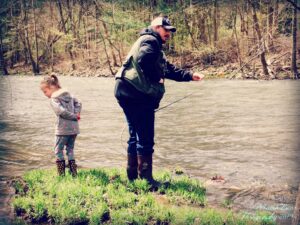
Photo by Marie Miller at Little Pine State Park
When to Fish
Seasons- While many fish can be harvested year-round, some fish are only legal to take while they’re in season. Look up the season of your target fish in your preferred waterway to determine when it is in season. Catch-and-release is typically allowed all year.
Trout Season- You may not fish on stocked trout waters on the first day of the season, which is the first Saturday in April.
How to Fish
No snag hooks- Snag hooks are never allowed on PA waterways. Snag hooks are grappling-hook shaped tackle that can impale (“snag”) a fish externally to reel in, as opposed to legal hooked where the fish has to bite the hook to be caught.
Three fishing poles- You may only use three fishing poles at a time to fish, unless you’re ice fishing, in which case the limit is five.
Illegal Baitfish- It is illegal to use goldfish, comets, koi, and common carp as baitfish. This is because those species are invasive in PA, so if something were to go wrong and the baitfish were released into local waterways, it could devastate the ecosystem.
No river obstructions- It is illegal to place obstructions in a river to block the movement of fish– no building a mini dam to trap the fish you want to catch in a small pool!
DO NOT LITTER- It is illegal to litter. Do not leave your fishing line in the bushes! Not only is littering illegal, but it’s common for wildlife to get tangled up in abandoned fishing lines, causing injury. Always be in control of your gear, and practice leave-no-trace while fishing. This includes any bait you use– do not dumb your bait!

Photo by Pam DiRado at Cook Forest State Park
How Can I Start Fishing?
Fish for Free Days
July 4 and the Sunday of Memorial Day weekend are Pennsylvania’s “Fish-for-Free” days. On these days, anyone is allowed to fish on Pennsylvania waters, even without a fishing license (following all other fishing regulations)! This applies to both residents and non-residents of the date, so if you want to give fishing a try without paying for anything, this is a great opportunity! Of course, fishing tackle can be expensive, but there are ways to save money on that, too.
Fishing Tackle Loaner Program
Fishing tackle can be expensive, and with so many options to choose from, it can be overwhelming to decide where to start. Luckily, the Department of Conservation and Natural Resources has coordinated with the Pennsylvania Fish and Boat Commission and the American Sportfishing Association to create a fishing tackle loaner program. In a similar manner to how you would borrow a book from a library, you can visit one of 38 loaner locations and try out fishing rod setup, free of charge! If you call ahead, there may even be helpful people with specific recommendations for beginners. A comprehensive list of tackle loaner locations can be found at: https://www.pa.gov/agencies/dcnr/recreation/what-to-do/fishing#:~:text=Through%20a%20partnership%20with%20the%20Pennsylvania%20Fish%20and,by%20at%20least%20one%20adult%20in%20the%20group. If you are looking for more information on how to begin fishing, the US Fish and Wildlife Service also provides a wealth of information at https://www.fws.gov/story/guide-fishing-first-time.

Written by Eleanor Meckley, PPFF Summer Intern
Eleanor is pursuing her Bachelor of Science in Biology at Shippensburg University and is part of the school’s 4+1 program, which will allow her to complete both her undergraduate and master’s degrees in just five years. Eleanor’s passion for the outdoors shines through her love of field research, hiking, and fish—she especially enjoys sampling streams and exploring Pennsylvania’s waterways. Hiking to remote sites and scrambling over rocks are just a few of the ways she connects with nature throughout all four seasons.