





As the lone star tick population has expanded from its historic southeastern range into Pennsylvania, so have cases of alpha-gal syndrome (AGS), an unusual allergy associated with lone star ticks that causes mild to severe allergic reactions to mammalian meat and other mammal products.
Unlike most other food allergies which are caused by proteins, AGS is caused by an allergic reaction to the carbohydrate alpha-gal. This carbohydrate can be found in all non-primate mammalian meat (beef, pork, lamb, venison, kangaroo, etc.), carrageenan (a food additive from red seaweed), and flounder roe. Alpha-gal is not found in birds (poultry and eggs), fish, reptiles, fruits or vegetables.
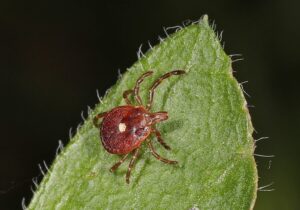
Lone-star tick, Judy Gallagher via Wikimedia Commons
For reasons that are still unknown to scientists, some tick species (such as lone star ticks), carry alpha-gal in their saliva. When any stage of the tick (larval to adult) bites someone, the alpha-gal in the tick’s salvia enters the body. Because somewhere in evolutionary history the gene that produces alpha-gal was deactivated in most primates (humans, apes, and old-world monkeys), when the tick’s saliva enters the bloodstream the body’s immune system begins to create antibodies to fight the foreign alpha-gal carbohydrate. Over the next several weeks, the body continues to build up antibodies to alpha-gal. When someone with this built-up army of antibodies consumes their next burger, the antibodies can cause an allergic reaction ranging from mild gastrointestinal irritation to life threatening anaphylaxis.
While other allergies tend to cause a reaction quickly after consumption, allergic reactions to alpha-gal are delayed, usually occurring two to six hours after consumption. This delay can make determining the cause of the reaction difficult for people who are not yet diagnosed with AGS. Reactions also vary from individual to individual. While 80-90% of people with AGS only need to avoid mammalian meat, some people must avoid all mammalian-derived products which can include dairy, gelatin, cosmetics, soaps, medications, fumes, and other everyday products.
Strangely enough, not everyone who gets bit by a lone star tick will develop antibodies and not everyone who develops antibodies will experience allergic reactions. Additional tick bites can also increase or change the severity of reactions for people with AGS. Over time, some people’s antibodies to alpha-gal may lower to levels safe enough to reintroduce mammalian products, however this may happen over the course of years and varies from person to person.
For those who do develop AGS, it can be a challenging condition to navigate since there is no requirement to have alpha-gal listed as an allergen on packaging. It is also a relatively new condition that is not fully understood. AGS was first discovered in 2009, and many health care providers (42%) are unaware of AGS, making it difficult to diagnose and dangerous when many medications (vaccines, pill coatings) and medical treatments (replacement heart valves) are derived from mammals and may contain alpha-gal.
While 14 states have mandatory reporting for AGS cases, Pennsylvania is not one of them. Between 2017 and 2022, 200 people were identified as living with AGS in Pennsylvania. However, this number is likely to grow as lone start tick populations continue to increase in PA and more people are properly diagnosed.
While their populations are still relatively low, lone star ticks are present throughout Pennsylvania. It’s a good reminder to wear long pants, use repellents, and take actions to prevent AGS and tickborne diseases.
For more information:
- Alpha Gal Factsheet (PA Department of Health)
- Lone Star Ticks (PA DEP)
- Tickborne Disease Prevention (PA Department of Health)
- Insect Repellent Finder Tool (EPA)
- Evolutionary History Helps Explain Mysterious Meat Allergy (UC Berkeley)
Written by Suzanne Hartley