


Pennsylvania’s state parks, forests, and surrounding public lands do more than conserve natural resources and protect diverse ecosystems and habitats. They also preserve our unique history and cultural heritage.
Pennsylvania has a rich industrial history and remnants of the past are still visible if you know where to look. Coal, oil, and lumber booms came and went, leaving towns, logging camps, and industrial settlements behind as resources dwindled and industries moved on.
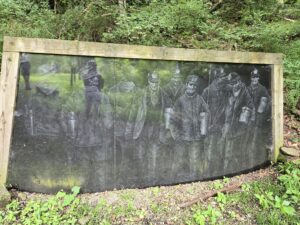
Ghost towns in the American West often get plenty of attention, but Pennsylvania has its fair share of them too! Centralia is perhaps one of the Commonwealth’s most (in)famous examples, but it’s far from the only one. The Ghost Town Trail, which runs through Indiana and Cambria counties, is a 54-mile rail trail named for the numerous mining towns that once existed along the railroad corridor. The trail was named Pennsylvania’s 2020 Trail of the Year, and the 32-mile C&I Extension loop was completed in 2026.
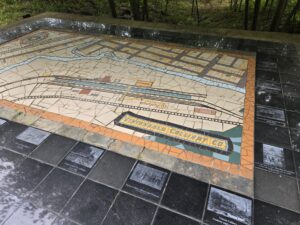
Ghost Town Trail mosaic; photo credit: Marci Mowery
Pennsylvania’s ghost towns tell the story of where we’ve been, how industry helped shape the Commonwealth we know today, and just how resilient nature can be. Here’s a few state parks and forests where you can explore some of these ghost towns for yourself.
Pandemonium – Tuscarora State Forest
Nestled in Henry’s Valley within Tuscarora State Forest, between Fowler’s Gap and Colonel Denning state parks, lie the remains of a ghost town with a rather ominous name: Pandemonium.
The town existed from 1787 to 1912 and once boasted around 100 homes, a steam tannery, several sawmills, and a cemetery. Today, visitors can still find remnants of the Pioneer Cemetery. Although most of the headstones have weathered over time, the gravestone of the town’s founder, Christian Henry, remains surprisingly legible.
For those who enjoy a little spookiness alongside their camping adventures, there’s even a campsite that puts you right in the middle of this historic ghost town! At campsite No. 92, you’ll find plenty of flat ground for pitching a tent, trees perfect for hanging a hammock, and remnants of the town’s past right at your feet. Camp here if you dare!
Antes and Beaver Mills – Black Moshannon State Park
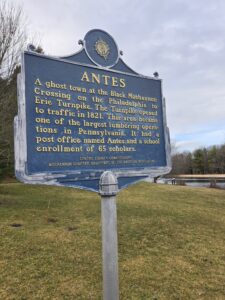
In 1821, the Philadelphia-Erie Pike (now PA Route 504) opened, helping spur settlement in the area. One of the early establishments was a tavern known as the Antes House, which welcomed weary travelers, pioneers, and sheep and cattle drovers making their way across the Allegheny Front.
The surrounding area was also rich in hemlocks and white pines, making it an ideal location for the Beaver Mill Lumber Company to establish operations. The company eventually became one of the region’s major logging enterprises.
By the turn of the 20th century, the communities of Antes and Beaver Mills featured a general store, mills, stables, a blacksmith and wagon shop, a tavern-hotel, a schoolhouse, and even a 10-pin bowling alley. Visitors can still see the schoolhouse near the park’s food concession stand.
Despite the belief that the supply of timber would never run out, the forests were eventually depleted. Lumber companies moved on, jobs disappeared, and the local economy collapsed. Intensive logging also left the landscape degraded and vulnerable to erosion and fires.
Soon after the logging industry left, a new group moved into town in 1933: the Civilian Conservation Corps (CCC). Beaver Meadow CCC Camp (S-71-PA), was established near the abandoned town of Beaver Mills and became one of the first CCC camps to open after the program was created.
It put over 200 young men to work conserving timber, water, and soil. They built roads to aid forest firefighting and planted trees to help reforest the land the lumber industry decimated.
Visitors today can travel CCC roads or hike among the rows of red pines the CCC boys planted. Structures this camp built are still in use today, including log cabins, food concession stand, picnic pavilions, and some hiking trails.
The story of this area also reflects a broader chapter in Pennsylvania’s history: the establishment of a state forest system to help restore and protect the Commonwealth’s over-exploited forests. Today, the forests surrounding Black Moshannon and numerous other parks in the state offer a reminder of how landscapes can recover from extensive environmental damage.
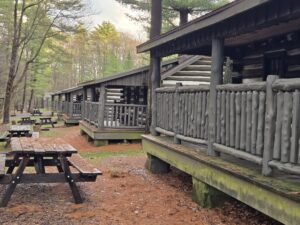 Log cabins built by the CCC boys; photo credit Marci Mowery
Masten – Loyalsock State Forest
Masten was once a bustling lumber town founded in 1905 by Charles Stones. At its height, the town was home to nearly 1,000 people and featured two sawmills, a clothespin factory, a schoolhouse, and an extensive network of railroads built to support logging operations. The area’s abundant hemlocks were also valuable for their bark, which was used in tanning leather.
When the logging industry declined, operations in Masten came to an end around 1930. However, the town’s story didn’t end there. During the Great Depression, the Civilian Conservation Corps (CCC) moved into the area and established Camp S-80, which remained active until 1940.
Today, Masten is a ghost town within Loyalsock State Forest. The former townsite serves as the trailhead for the Old Loggers Path hiking trail, where visitors can still spot remnants of old foundations and a smokestack. These surviving structures offer a glimpse into the area’s logging history and the communities that once thrived here.
Poe Mills – Poe Paddy State Park
Poe Mills was a prosperous but short-lived lumber town that flourished during the 1880s and 1890s in what is now Poe Paddy State Park. At its peak around 1890, the town had a population of more than 300 people. Situated along Big Poe Creek, the settlement relied on a dam that supplied water to its steam-powered sawmill.
The main railroad line, built in 1879, ran near Poe Mills while a spur track extended into the Poe Paddy area. Like many logging communities throughout Pennsylvania’s mountains, the town was also connected to a network of smaller, temporary railroads that transported timber out of the surrounding valleys.
Eventually, timber operations shut down, and the community faded away, leaving stone foundations as some of the few remaining traces of its past.
In the mid-1930s, the Civilian Conservation Corps established Camp S-63-PA in the valley. The men stationed there helped develop campsites and trails at Poe Paddy and Poe Valley state parks, contributing to the recreational opportunities visitors can still enjoy today.
Oil Creek State Park
Northwestern Pennsylvania played a pivotal role in the birth of the modern oil industry. In 1859, Edwin Drake drilled a successful oil well just north of what is now Oil Creek State Park, helping launch an oil boom that would transform the region and the world.
The discovery drew thousands of people into the valley as boomtowns sprang up and prospectors rushed to strike it rich in the search for “liquid gold.” But the rapid growth came at a steep environmental cost. Oil and mud mixed together on unpaved roads, making them impassable. Oil polluted the creek and the air became so saturated with petroleum fumes that the smell was unavoidable.
The landscape has changed dramatically since those early days, but remnants of its industrial past remain scattered throughout the park. Visitors can spot historic oil equipment, abandoned wells, the remains of oil-related infrastructure, and crumbling walls that hint at the area’s once-booming industry.
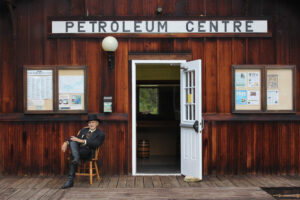
Petroleum Centre that’s open to visitors; photo credit Dot Monahan
Oil Creek State Park offers a fascinating look at how a landscape can change over time and how nature can begin to recover from industrial impacts. The contrast between the region’s early oil boom and its present-day forests and streams tells a powerful story of environmental change and renewal.
With opportunities to hike, bike, fish, explore historic sites, and more, Oil Creek State Park invites visitors to experience both the natural beauty of Pennsylvania and the history that helped shape it.
Resources and Sources used:
Indiana County Parks & Trails, Ghost Town Trail History: https://indianacountyparks.org/our-trails/ghost-town-trail/ghost-town-trail-history/
Jim Cheney, Uncovering PA: https://uncoveringpa.com/
Hiker Dude Dad, YouTube: https://www.youtube.com/@HikerDudeDad
Written by Carla Eissing
Carla is the Outreach and Communication Coordinator at the PA Parks and Forests Foundation. She earned her bachelor’s degree in Geography/Human-Environmental Studies from Shippensburg University and has been working in the non-profit and environmental education world for over a decade.