
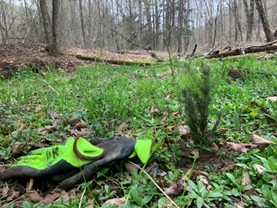
In the rural valleys of Northcentral Pennsylvania lives a small group of fishermen that have a deep passion for their streams and forests. The Pine Creek Watershed Council (PCWC) in conjunction with the Tiadaghton Chapter of Trout Unlimited (TU) have had one simple mission they partake in every spring: “Plant a tree, shade a trout.”
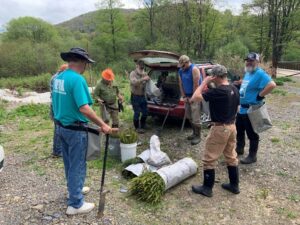
The group gathering for pre-planting instruction.
A riparian forest is a wooded area made of trees, shrubs, grasses, and forbs located alongside a waterbody. These areas are vital for healthy streams because they provide a filtration layer from polluted runoff and sediment, stabilize streambanks, offer habitat and food, and shade the stream to help keep water temperatures cool. PCWC/TU fully understand the benefits of a riparian forest because that is where they go fishing! This is why they work tirelessly every year to expand and improve the riparian forests within the Pine Creek Watershed.

Dibble bar and a newly planted tree
They take a unique approach to their planting by only planting bare root conifer trees. You are probably wondering why only conifers, but if you have ever taken a hike in the woods, then you know there is a stark difference in temperature when you enter a thick canopy made of pines and hemlocks versus only deciduous trees. Speaking of hemlock trees, this program is also planting different conifers to replace our state tree as they fight their battle against hemlock woolly adelgid, a nasty aphid-like bug plaguing the area. Some of the trees they enjoy planting are white pine, red spruce, and balsam fir, but their favorite tree by far is an introduced species to PA, the Norway spruce.

Picture of Hemlock Woolly Adelgid on a branch
The Chair of the PCWC, Jim Weaver – who is more Lorax than man at this point in his life – has been leading the charge on this program for over 7 years. When he first started the program, he remembers that a lot of conservation professionals looked down on his approach since he did not perform any site prep or fencing around his plantings, which would result in survivability being much lower than the typically required 70% for other programs. His response, “Let’s say we get 50% survivability, and I come back the following year. Is that 100%? What if I do that a third year, do I achieve 150%?” The math is hairy, but I agree with the concept of keeping conservation simple to promote more community engagement and involvement.
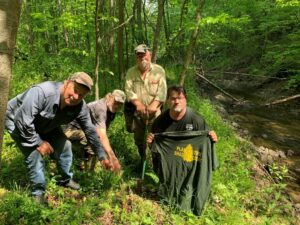
Group of club members pointing out a tree they planted. Jim Weaver is holding the dibble bar.
With only volunteers, this group has been able to plant over 20,000 trees and cover 12 stream miles. Those are amazing numbers for a simple program with an awesome premise. This is an easy and replicable project within any watershed. Come and explore the forest here in the Upper Pine Creek Watershed and try to spot some of the Norway spruces that are planted in the riparian zone. And if you find two trees growing together, just know a TU member planted his famous “twofer.” So go, plant a tree, and shade a trout!
Grab some gloves and leave a mark in your watersheds!
 Written and photos provided by Tyler Upham.
Tyler is a Tioga County native and has been working as Tioga County’s Watershed Specialist for over 6 years. He received his bachelor’s degree in Environmental Biology from Liberty University, located in Lynchburg, VA. He has been an outdoorsman since his youth but truly fell in love with resource management as a whole after becoming an ultrarunner. Running has allowed him to see watersheds in their entirety, from the peak of the mountain to the bottom of the valley. Tyler’s main goal as a conservationist is to keep conservation fun and simple so that others might be interested in joining his mission.