
As an intern with PPFF this summer, I conducted interviews with a few Friends Group volunteers to learn about their motivations and experiences. I had the pleasure of interviewing Amanda Kline, Secretary for Friends of Milton State Park, Emma Grove, Treasurer for Friends of Michaux State Forest, and Carl Harting, Chair of Friends of Cook State Forest. All three of these individuals come from different backgrounds—speech and language pathology, accounting, pharmaceuticals—and different walks of life. Yet, they all care deeply about the environment, and they have found themselves involved in the world of outdoor volunteerism.
In the interviews, I asked six main questions about their volunteer experience:
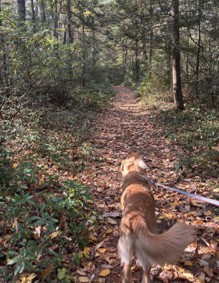
Emma and her pup in Michaux
- How and why did you get involved?
- What is an accomplishment you are most proud of achieving as a volunteer?
- Have you learned any new skills volunteering?
- What is something you think people don’t realize about volunteer work?
- What would you say to someone who is interested in volunteering but hesitating to make the commitment?
- What is your favorite memory?
How and why did you get involved?
Amanda Kline:
“My husband and I both volunteered at that time because we wanted to give back to the community, but we also felt like Milton State Park is a really big resource for our community for exercise, for engagement in nature….We just thought it was a really valuable environment for us to put our time into.”
Emma Grove:
“I started my full time job where I work at an accounting firm, and they really like to emphasize community involvement. That’s really important to our company, so I was kind of thinking of what I could be involved in that is also a reflection of my personal interests…I hike out there a lot, I go out with my family there a lot… I use Michaux State Forest, so it just felt a little bit more like it meant something”
Carl Harting:
“I had just lost my father, and I just thought you know that’s part of my life. I just wanted to be involved in something I really cared about, and you know I spent my entire childhood at Cook Forest. So I just thought you know maybe it was time to start giving back. I started volunteering at the park with the naturalist, Dale, and after a number of years, I heard that they were forming a Friends Group.”
What is an accomplishment you are most proud of achieving as a volunteer?
Amanda Kline:
“I think that the biggest project we were able to do at Milton State Park was the trail system. There was not a trail system at all in that park, so it was completely starting from scratch. It was cutting trees and battling knotweed…making those trails and planting grass seeds…Then to maintain those trails and lots and lots of mowing. So without the Friends Group, there would actually not be a trail system at Milton State Park. The main reason is because that park floods almost yearly, so DCNR did not want to put resources into that park, knowing that on a yearly basis they would lose a lot of their work or potentially could lose a lot of their work. So, all the trail systems on the island at the park are maintained by the Friends Group…And I think we’re particularly proud of that trail system since the pandemic in 2020 or so. That trail system has become extremely popular to the point where some of the mowing doesn’t even need to take place because the paths are so worn from use, which we’re so happy that many people in our community are getting out in nature and using those trails.”
Emma Grove:
“It’s sometimes hard to find people who can do specified jobs all the time, and I noticed that the social media pages like Instagram and Facebook were maybe not informing members enough about what was going on. As someone who’s you know, I’m a little young, I like to think I’m good with technology, so I offered to take over that as well…I use Canva, I try to put together flyers, I put together schedules that kind of thing….The chair will send me a schedule, I put together a graphic or a post for it, and we get it put up right away. So I think we’ve been achieving more of a connection with the members because they’re not just donating money and then not hearing about anything we’re doing. They’re seeing that we have volunteer days set up. They’re seeing that we have these events for members like we have a picnic in August coming up. So that’s one thing I think we’ve accomplished this year and over the last year.”
Carl Harting:
“The biggest project, well, the most well-known project, that we’ve done was the updating of the trail that was put in in 1982. It was called the Paved Trail. Basically, it was a flat quarter-mile loop trail that allowed people with disabilities, whether it was a wheelchair or if people were using crutches or whatever, it allowed people to get out and to be in the forest…So that had been in place, but it was deteriorating. I think four years ago, maybe five, we had an idea from another board member to update that trail instead of just having it being pavement. The idea was to put a guide wire with benches and braille signage, so the blind could use the trail and learn about what they were hearing around them or what they could feel because we had the signs next to trees. They could…feel the bark of the tree, they could they could touch and they could hear, so it just allowed them to use their other senses and still experience the park.”
Have you learned any new skills volunteering?
Amanda Kline:
“So much! I think the main thing was…Japanese knotweed…It’s super invasive…so now every town along the Susquehanna River is flooded with this plant, and it’s just a constant battle. But I didn’t even know anything about it prior to volunteering. I also didn’t realize that the Milton State Park used to be a landfill. So in cleaning up the state park to put in our trail system, we had years and years and years of garbage to take out of that park to make it into what we know today because of its use as a landfill for so many years in the past.”
Emma Grove:
“Canva is one that I have learned…And then, I would say that just learning more about like Michaux…So when we have our members meetings we’ll usually have a speaker or something right before our meeting, and it’s just as interesting to me as it is to the other members. I’m learning a lot…I’m learning personal connections with all these people. I’m learning how to organize all these treasurer workpapers. I’m learning about social media and graphic design. And then that outdoors stuff as well.”
Carl Harting:
“I’m using the same skills I used in my previous job. I was a supervisor there, leading projects and trying to keep people on task and focused on the goal. I’ve certainly learned a lot more about nature, you know, about the birds and the trees during my time on the board, and even previous to that when I volunteered [before joining the Friends Group].”
What is something you think people don’t realize about volunteer work?
Amanda Kline:
“I don’t think they know that we exist…as a Friends Group, so we’re working really hard to try to do some more things. Getting volunteers is super tough. I think everybody knows that for any organization. But just getting the word out that we do exist and that we could use some help every now and then.”
Emma Grove:
“I think I think people might just not realize how much actually goes into play. Like it takes a lot of hands and volunteers to do what you have to do, especially for Michaux because it’s such a big area. So I mean, if anyone sees this and wants to be involved, we have plenty of volunteer opportunities. We have to have stewards who go out and take care of the trails. We have a Sawyer team, so they take care of trees that are down. There’s an invasives and habitat team, so there’s a lot of stuff that happens on the ground that needs people to actually be a part of it. And then behind the scenes, like the administrative stuff, that’s kind of more my part. There’s membership committee, executive committee, all kinds of things that have to be done. Someone has to run the social media accounts. Someone has to keep track of the money. Someone has to send out the membership cards and keep track of the people who are signing up for memberships. So there’s just a lot that has to happen, and a lot of people that have to work together to be able to do everything that we do and to keep the trails up and running and looking great.”
Carl Harting:
“I don’t think that many people realize that what we do is completely…[without] reimbursement…We donate our time, we donate our energy. Everybody assumes that it’s a state park, so the state should pay for everything. They don’t realize that [the state isn’t] able to pay for you know, for example, the paved trail that we converted into a sensor trail. They don’t realize that you know without us, they may not be able to replace the playground. That’s our current project…replacing the playground at our campground at the park, and they don’t realize that being a state park, that they still have the need for volunteers and for extra fund raising.”
What would you say to someone who is interested in volunteering but hesitating to make the commitment?
Amanda Kline:
“If the volunteer is not sure about the time commitment, I would definitely focus on that and how relaxed and how minimal the actual time commitment is. But I think too, honestly, walking the trails and just picking up sticks so we don’t get stuck in the mower. Some of that stuff is just the most helpful.”
Emma Grove:
“I would say that it can be whatever you want to make it. So if you’re someone like me, who has a full-time job and maybe you don’t have a ton of time to do the outdoor stuff… you can commit however much time you want to. So if you want to do one volunteer day on a Saturday, you can do that. If you want to spend more time, you want to join the board. You want to be the chair of the membership committee, you can do that too. So it’s kind of up to you, up to your schedule, whatever you have time for, and we’d be grateful for it.”
Carl Harting:
“It’s rewarding. It doesn’t have to be very difficult. Volunteers don’t have to commit themselves to eight-hour days of hard physical labor or long days of preparing for events. We try to make it fun, we try to make it so that you can enjoy whatever activity is occurring while you’re helping, you know, helping the park out. So yeah, it’s not all hard work, and we do you know work, but I think it can be a rewarding experience for someone who just wants to give a little. You don’t have to give entire days or long hours. They can just help out a little bit and be appreciated by a group of people.”
What is your favorite memory?
Amanda Kline:
“I think that one of the best memories is how over the years we’ve had volunteers come and go, we’ve had board members come and go, but there’s always the common goal of maintaining that park and keeping it for our community. I think that some of the workdays that we’ve had in the fall and spring have just been really rewarding. In the past, actually, I mean the past past like more than 10 years, we did have a fraternity from Bucknell come, and one of the best times was getting those guys…in the river and removing old tires from the river for recycling. That was just a hoot watching those guys…That was just an entertaining day. But those cleanups now involve students from the Milton High School that need volunteer hours, and they’re out there helping us. I just think those volunteer days for cleanups and plant things are some of the most memorable days.”
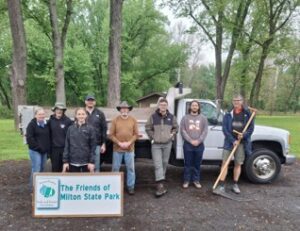
Friends of Milton after a trail day
Emma Grove:
“I think my favorite part is just meeting the people…It’s really nice to have a connection with people all over the area. And then I think favorite memories…goes with the most positive parts of it. We have so many events that you can help with, and there’s so many different things to do. We have a Michaux Gravel Bike Race in September, and they ask for volunteers to help with an aid station, and I did that last year. We just had so much fun. We set up music. There were probably four or five of us at a time, but 10 people coming in and out throughout the day, and I got to meet new people. I got to hang out with people I already knew. We just hung out. We listened to music. We had some snacks, and then you get to see all these bike racers coming through. So that was a super super fun day. And then we also have a running race as well, a trail race, which I actually ran in last year, so I wasn’t part of the aid station helper group. But it was so fun to go through and you know see everybody up there cheering for me, and they were all standing out there with the snacks and drinks and stuff. It’s just a super positive atmosphere. You get to build relationships you might not have built before, and it honestly is fun.”
Carl Harting:
“I guess it would be the memory of the dedication of our paved sensory trail. We had you know a couple newspapers there. We had park management and DCNR folks. We had a little ceremony…short speeches by a couple of us, and it was just a great group. I think it was like 30 people, and it was really just good to know kind of bask in the recognition I supposed that we earned from the project…It was also good to get people together. We got people there who were using wheelchairs and enjoying the trail with us. It was just a really good feeling to know that we had accomplished such a worthwhile goal.”
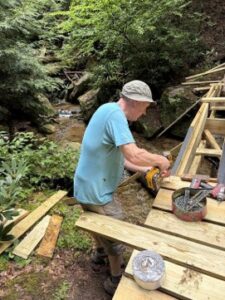
Carl Harting building a bridge on the North Country Trail in Cook Forest State Park
I want to end this article with a call to action because my main take-away from the conversations with the volunteers is that many hands make light work. There is always work to be done in the parks and forests, and any bit of help no matter how big or small is appreciated.
Check out the Pennsylvania Parks and Forests Foundation website to learn more about getting involved.
Annalise Velazquez is a recent graduate from Bucknell University where she majored in Environmental Studies and Economics. She was an intern with Pennsylvania Parks and Forests Foundation during the summer of 2026.