
My Unexpected Loss of Mobility
Fun and relaxation to me means time spent outdoors, either working in my gardens or exploring day-hikes throughout southcentral Pennsylvania (PA). In June 2025, a minor knee procedure resulted in a blood clot in my leg. Complications from this clot have left me unable to walk for more than 10 to 15 minutes at a time, challenging my ability to recreate in my usual ways. There has been no hiking, no gardening, and no walking my dogs.
I am in physical therapy now, seeking to reduce pain and regain function. In the meantime, I purchased a basic wheel chair, so that I could at least try to experience the outdoors from time to time.
Watching and Wheeling Outdoors
At first, I tried just sitting in nearby parks. At least I could sit outdoors, observe wildlife, and hear leaves rustle. Now, when I pull into a parking lot, I find myself asking new questions. How close is the nearest park bench, and can I see anything interesting from that vantage point?
My first big outing with my wheelchair was in Phoenixville, PA to explore the town and Schuylkill River Trail. A fresh perspective here? There is a road crossing along the Trail that looks handicap accessible, but in fact there is a ¼-inch lip between the ramp and road surface – a big roadblock for my non-motorized wheelchair.
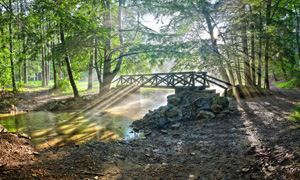
As I began exploring small parks alone in my wheelchair, I experienced more fresh perspectives. What appears to be a flat walking path is indeed not flat at all – it has a grade and a cross-grade that demand great effort from my arms. I didn’t even know what a cross-grade was before experiencing it in a wheelchair. (It is a grade perpendicular to the trail’s path – often imperceptible to people on foot.)
These fresh perspectives make me appreciate that what may look like easy terrain to many people (including me pre-surgery) could be challenging to traverse for people with mobility differences. Maybe the engineers designed it as ADA-compliant, but was it actually constructed that way?
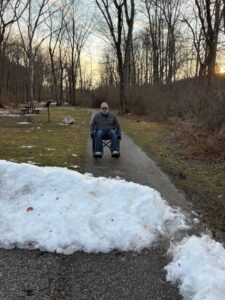
Photo credit: Ryan Szuch
Positive Lessons Learned
These experiences bring positive fresh perspectives, too. When you are moving very slowly – there is more time to look around, be mindful, and observe details. I also have a newfound appreciation for small parks with infrastructure (such as park benches) that I would not ordinarily use. Are rugged hikes and mountain bike trails the preference of many outdoor enthusiasts? Sure. Are these experiences usually reasonable for the elderly or those with mobility limitations? Not really. Our township and state parks are vitally important as accessible recreation options for all.
My most impactful learning has been that equity, inclusion, and accessibility programs are not just for THEM. They are not just nice ideas that we think about for others. It can take just one change in circumstances, and such work becomes important to US, too. Inclusive and accessible recreational opportunities have the potential to benefit us all.
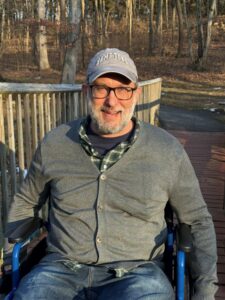
Photo and writing credit: Ryan Szuch, Founder & President, Grow Conservation LLC